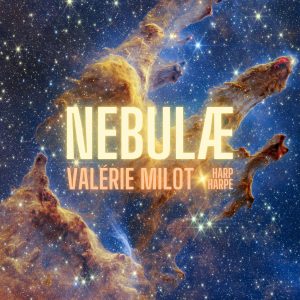
Yesterday afternoon at L’Anglicane, time stood still. Before Valérie Milot even set foot on stage, a recorded message from Francis Reddy gently prepared the audience to dive into the immensity. Nebulae, nebula — the title already sets the tone: the universe, stardust, mystery. From the very first moments, the harpist establishes a bridge between astronomy and music, reminding us that these two worlds may not be so far apart after all.
The artist appears, luminous and serene. She speaks softly, as if every word must float for a moment before settling. In her opening remarks, she quotes Carl Sagan — that scientist-poet who looked at the Earth as a simple pale blue dot lost in the cosmos. “This is where all of human history has taken place,” he once said. And suddenly, the infinite becomes intimate.
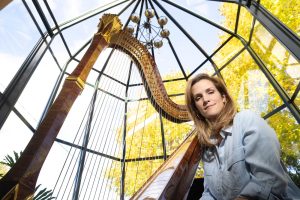
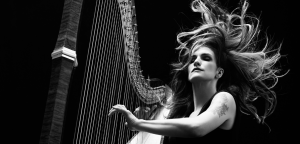
When she takes her place at the harp, it is as though her body becomes an extension of the instrument. She sways gently, caresses it, makes it resonate as one would with a kindred soul. She does not play — she breathes through the strings. Her face remains serene, almost transported. The entire room holds its breath. Some close their eyes, choosing to experience the music from within, to feel it fully and without filter, as if each note finds its echo inside them. The first applause breaks out timidly after the second piece, as if the audience fears shattering a fragile spell.
Between pieces, Valérie Milot rises and tells the story of everything that is. The Big Bang. The birth of stars. The formation of the Sun, then the Earth. She recounts these 14 billion years with simplicity, almost tenderness. She tells us that sunlight takes eight minutes to reach the Earth, and that humanity itself is only 300,000 years old. Everything becomes relative. And suddenly, the music takes on a new dimension.
Beneath her fingers, the harp becomes a galaxy. She plucks, slides, grazes the strings with her fingertips, her knuckles, her palm. She evokes the first eight-string harp, before reminding us that today’s instrument has forty-seven strings and a pedal system that triples its sonic possibilities. This detail fascinates as much as it astonishes: how can a single woman command such a complex instrument? And yet she does so with ease, with love.
She performs works by Gabriel Pierné, Amélie Fortin, Claude Debussy, Christoph Willibald Gluck, William Bolcom — worlds that follow and respond to one another. Debussy’s Clair de lune is undoubtedly the pinnacle of the recital: suspended in a near-sacred silence, it sends a shiver through every corner of the hall. The emotion is pure, almost mystical. The harp seems to weep and smile at once.
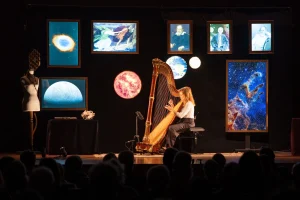
Between pieces, humour enters the room. Valérie Milot jokes about baby boomers, riffs on Ricardo and his best muffin recipe, and mimics Orpheus in a theatrical falsetto that makes the audience laugh. Behind her, an illuminated screen displays images: portraits of scientists, constellations, old paintings. Copernicus, Galileo, Debussy — all intersecting in a fresco where science, art, and humanity embrace.
The audience, spellbound, never quite knows when to applaud. At times she flows from piece to piece without pause, leaving mystery in the air. At other times she stops to offer us a fragment of knowledge. We learn that the Catholic Church did not officially lift its condemnation of Galileo until 1992. We discover that, according to Hubert Reeves, ‘we are made of stardust.’ Everything coheres: the music, the words, the images.
Valérie Milot transforms the stage into a laboratory of emotions, a luminous cathedral where each note is a prayer addressed to the universe. She succeeds in making science poetic, and poetry universal. It is rare, and it is magnificent.
The show ends in near-sacred silence. The applause erupts, long and sincere. The artist returns, smiling, but confides that there will be no encore: she injured her hand earlier in the day. She shows her palm, faintly bloodied. And yet she played through the entire concert without once faltering. The audience is moved. It takes an exceptional musician to transform pain into beauty.
Yesterday, at L’Anglicane, Valérie Milot proved that the harp is not merely an accompanying instrument, but a universe unto itself — one capable of containing the roar of the Big Bang and the tenderness of moonlight. That between two wingbeats, between two stellar pulses, there exists a place where everything becomes music.
And that is exactly where Nebulae found us.